WELLINGTON COUNTY – The living wage has increased across Dufferin, Wellington, Guelph and Waterloo, with workers in the region now needing to earn at least $23.40 an hour to cover basic expenses.
The 2026 figures were released Monday, November 9th, by the Ontario Living Wage Network (OLWN), which calculates how much workers need to earn to afford necessities and participate in their communities.
The new hourly rate represents a 40-cent increase from last year’s $23.00.
The Dufferin, Guelph, Wellington and Waterloo region now has the fourth-highest living wage in Ontario, behind the Greater Toronto Area at $27.60, Ottawa at $24.10, and Grey, Bruce, Perth, Huron and Simcoe at $24.75 an hour.
“Although the increases in Ontario’s living wage rates may be more modest than expected given the current economic climate, the Ontario Living Wage Network’s priority is to ensure that rates are calculated accurately and consistently, using an evidence-based methodology,” OLWN said on its website.
Ontario’s minimum wage increased by 35 cents in October, bringing it to $17.95 an hour. That leaves a $5.45 gap between minimum wage and the living wage in Dufferin, Guelph, Wellington and Waterloo.
The Ontario Living Wage Network says every region in the province has a living wage above the current minimum wage, with the difference ranging from $3.20 to $9.65 an hour.
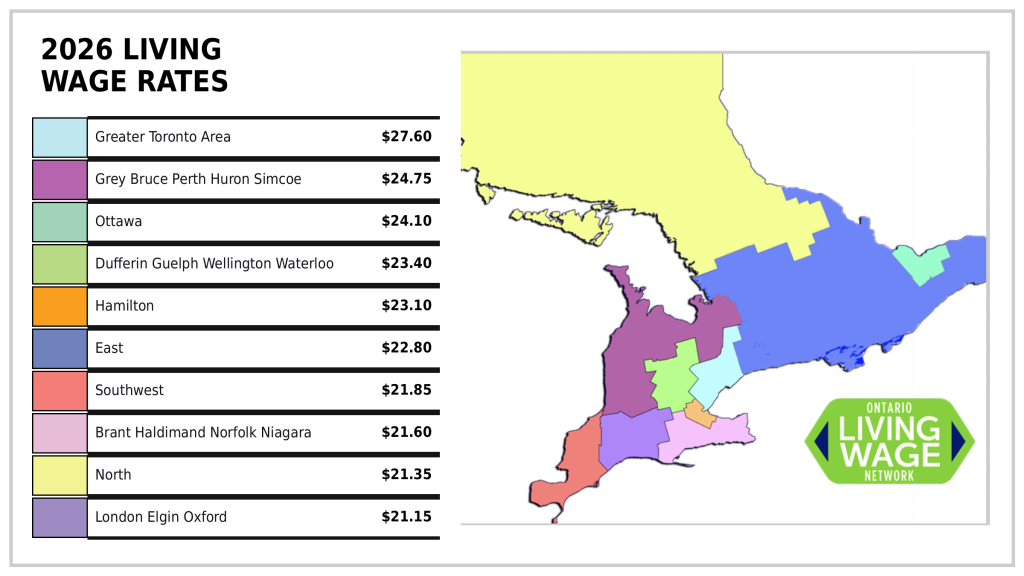
Photo from: ontariolivingwage.ca (The 2026 living wage rates across Ontario. Dufferin, Guelph, Wellington, and Waterloo share a regional rate of $23.40 an hour)
The cost of housing continues to be one of the biggest factors behind the living wage calculation.
According to the 2026 regional figures, annual shelter expenses for a family of four in Dufferin, Guelph, Wellington, and Waterloo total $26,525. That includes rent, utilities, and tenant insurance.
Childcare is another significant expense, costing a family of four an estimated $13,204 annually. Food costs are also adding pressure, with the same family expected to spend $13,024 a year on groceries — an increase of more than $1,000 from last year’s calculation.
The Ontario Living Wage Network says it calculates its rates using three different household types: a single adult, a single parent with one child, and a family with two parents and two children.
The calculation considers expenses including housing, food, transportation, clothing, childcare, insurance, medical costs, and other household necessities.
It also accounts for government benefits and tax credits families may receive, along with income taxes and payroll deductions.
The organization also reports that “ More than 600 employers in the province are certified living wage employers, having committed to this standard. Our goal is to raise wages in Ontario and address poverty through paid work.”